

Pyramids Global | Monthly RCM Brief — October 2026
ONE MONTH IN: WHAT UNITEDHEALTHCARE’S 1,700-CODE PRIOR AUTH CUT ACTUALLY CHANGED
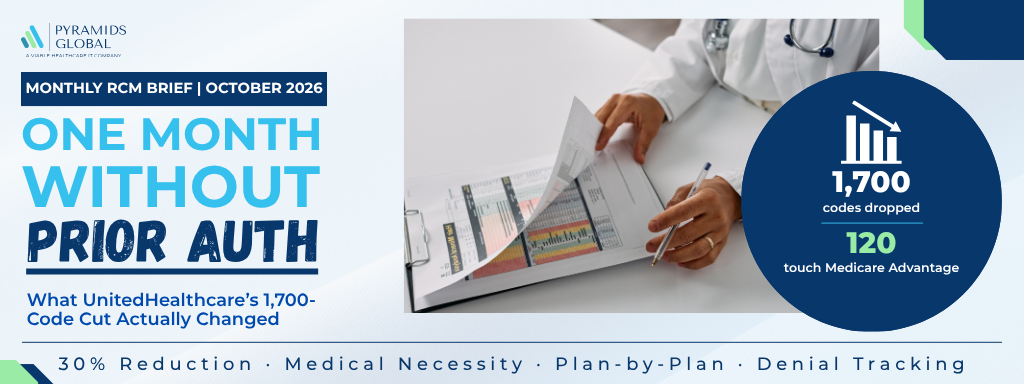
A month ago, the biggest prior authorization news of the year took effect. On October 1, 2026, UnitedHealthcare removed prior authorization on roughly 1,700 procedure codes, about a 30% reduction, across its commercial, Medicare Advantage, Community (Medicaid), Individual Exchange, and Oxford plans. The headline read like broad relief. Thirty days in, the picture is clearer, and more conditional, than the announcement suggested.
WHAT ACTUALLY CHANGED IN UNITEDHEALTHCARE PRIOR AUTHORIZATION
The reduction is real and substantial. As reported by Becker’s, the exempted codes span lesion excisions, fracture treatments, joint injections, arthroscopies, colonoscopies, endoscopies, biopsies, hernia repairs, and soft-tissue tumor removals, with genetic and molecular testing making up a large share of the list UnitedHealthcare has framed it as part of its pledge to cut prior authorization by 30% before year-end, noting that prior authorization applied to only about 2% of its medical services and that roughly 92% of requests were already approved in under 24 hours on average.
THE UNITEDHEALTHCARE PRIOR AUTHORIZATION FINE PRINT THAT DEFINED THE MONTH
For practices, the first month confirmed what the headline left out.
The scope narrows sharply by plan. Of the ~1,700 codes, only about 120 apply to Medicare Advantage and dual special needs plans, according to RCM analysis of the release. A code dropped on commercial may still require approval under Medicare Advantage or Medicaid.
Removing prior authorization does not remove medical necessity. Industry guidance throughout October stressed the same point: a service that no longer needs pre-approval can still be denied after the fact if documentation doesn’t support it, and in some cases, advance notification is still required even where prior authorization isn’t.
Whole segments saw little change. Leading Age noted the cuts offer scant relief to skilled nursing and home health, where the burden may simply shift from authorization to the point of payment. Behavioral health guidance was blunter still: residential, inpatient psychiatric, PHP, IOP, substance use, and ABA services largely still require authorization. The reception across the industry has been, as MedPage Today put it, muted applause.
The scope narrows sharply by plan. Of the ~1,700 codes, only about 120 apply to Medicare Advantage and dual special needs plans, according to RCM analysis of the release. A code dropped on commercial may still require approval under Medicare Advantage or Medicaid.
Removing prior authorization does not remove medical necessity. Industry guidance throughout October stressed the same point: a service that no longer needs pre-approval can still be denied after the fact if documentation doesn’t support it, and in some cases, advance notification is still required even where prior authorization isn’t.
Whole segments saw little change. Leading Age noted the cuts offer scant relief to skilled nursing and home health, where the burden may simply shift from authorization to the point of payment. Behavioral health guidance was blunter still: residential, inpatient psychiatric, PHP, IOP, substance use, and ABA services largely still require authorization. The reception across the industry has been, as MedPage Today put it, muted applause.
WHY IT MATTERS FOR REVENUE?
The risk this month wasn’t the policy — it was the assumption. Practices that read “1,700 codes”and relaxed verification or documentation are exactly the ones exposed to post-service denials, where there’s no authorization trail to fall back on. The ones who benefited treated the change as narrower and more conditional than the headline, and verified before they adjusted.
WHAT PRACTICES ARE LEARNING ABOUT UNITEDHEALTHCARE PRIOR AUTHOIRZATION?
Confirm, per plan, which codes truly came off the list for your payer mix, not just that they appear on it. Keep documentation strong where authorization is no longer required, since medical necessity reviews didn’t go anywhere. Track denials on the removed codes over the next 90 days, and if one starts denying for authorization, escalate with the payer citing the October 1 list. And review whether your high-performing providers qualify for the gold-card bypass.
THE BOTTOM LINE
A month in, UnitedHealthcare’s prior auth cut looks less like a clean win and more like a test of operational discipline.Less prior authorization should mean faster care,but only for the practices that verified the details instead of trusting the headline.
If your team wants to map which UnitedHealthcare codes genuinely came off the list for your plans, and keep documentation tight where approval no longer applies, the team at Pyramids Global can walk through it with you on a consult.
If your team wants to map which UnitedHealthcare codes genuinely came off the list for your plans, and keep documentation tight where approval no longer applies, the team at Pyramids Global can walk through it with you on a consult.